Concept
PCC Transitions
Factors associated with persistent post-COVID-19 condition and functional limitation four years after SARS-CoV-2 infection | Scientific Reports / Changes over Time (PCC cohort 2021 until 2024)
"Of the 609 participants with PCC in 2021, 354 (58.1%) were successfully followed up in 2024.\n\nFigure 2 shows the transitions between PCC and recovery status over time. Most participants (274 [77.4%]) continued to meet criteria for PCC, whereas 80 (22.6%) had fully recovered. By 2024, 59 subjects had newly developed PCC. In total, 333 participants met PCC criteria, of whom 274 (82.3%) had persistent and 59 (17.7%) new-onset PCC.\n\nFig. 2\n\n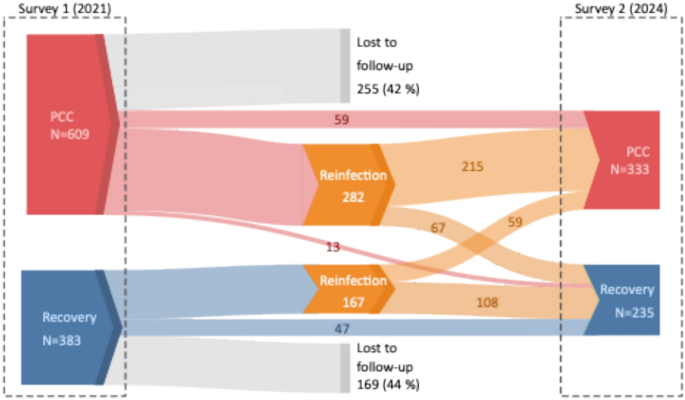\n\nTransitions in post-COVID-19 condition (PCC) status between the first (July–August 2021) and second (March–September 2024) follow-up surveys. PCC, post-COVID-19 condition. Transitions in post–COVID-19 condition (PCC) status between the first follow-up survey (July–August 2021) and the second follow-up survey (March–September 2024), illustrating persistent PCC, new-onset PCC, recovery, and loss to follow-up. Participants categorized as “Lost to follow-up” did not complete the second follow-up survey."
Related Ideas
- Persistent PCCFactors associated with persistent post-COVID-19 condition and functional limitation four years after SARS-CoV-2 infection | Scientific Reports · Factors associated with persistent PCC (2021–2024)
- Functional LimitationFactors associated with persistent post-COVID-19 condition and functional limitation four years after SARS-CoV-2 infection | Scientific Reports · Definition of post-COVID-19 condition
- Persistent PCCFactors associated with persistent post-COVID-19 condition and functional limitation four years after SARS-CoV-2 infection | Scientific Reports · Statistical analysis
- Population StabilityFactors associated with persistent post-COVID-19 condition and functional limitation four years after SARS-CoV-2 infection | Scientific Reports · Changes over Time (PCC cohort 2021 until 2024)
- Follow-up CohortFactors associated with persistent post-COVID-19 condition and functional limitation four years after SARS-CoV-2 infection | Scientific Reports · Baseline characteristics second follow-up survey (March–September 2024)
- Study LimitationsFactors associated with persistent post-COVID-19 condition and functional limitation four years after SARS-CoV-2 infection | Scientific Reports · Strengths and limitations
- Statistical AnalysisFactors associated with persistent post-COVID-19 condition and functional limitation four years after SARS-CoV-2 infection | Scientific Reports · Statistical analysis
- Participant RecontactFactors associated with persistent post-COVID-19 condition and functional limitation four years after SARS-CoV-2 infection | Scientific Reports · Follow-up survey (phase II)