Concept
PCFS Changes
Factors associated with persistent post-COVID-19 condition and functional limitation four years after SARS-CoV-2 infection | Scientific Reports / Changes over Time (PCC cohort 2021 until 2024)
"Figure 3 illustrates the corresponding changes in PCFS grades among participants with available follow-up data (n = 354). Between 2021 and 2024, 105 (29.7%) showed improvement, 193 (54.5%) remained stable, and 56 (15.8%) experienced worsening. Functional recovery was most common among those with no or negligible baseline functional limitation (PCFS < 2), whereas worsening occurred in 49 of 273 participants (17.9%) with baseline PCFS grades 0–1 and in 7 of 81 participants (8.6%) with baseline PCFS grades ≥ 2.\n\nFig. 3\n\n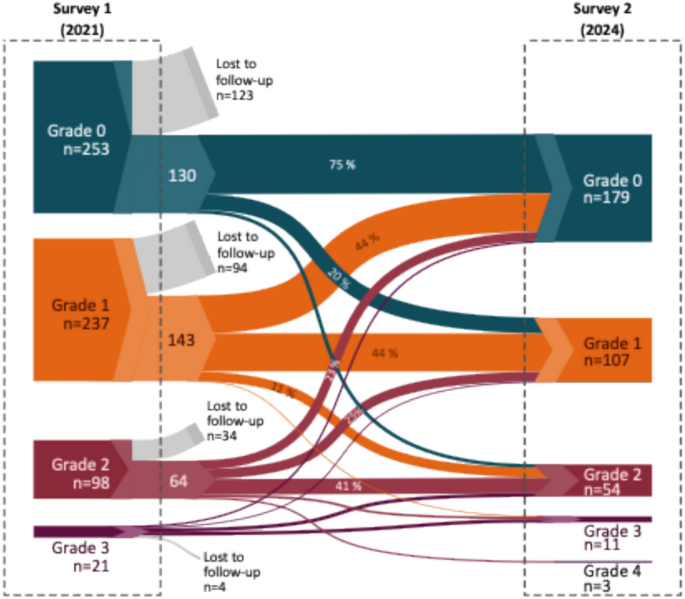\n\nChanges in post-COVID-19 Functional Status Grades Between 2021 and 2024. PCFS, Post-COVID-19 Functional Status. The figure shows PCFS grade distributions in Phase I and transitions to PCFS grades in Phase II among participants who completed follow-up. Participants who did not complete Phase II are shown separately as lost to follow-up. Percentages indicate the proportion of participants within each baseline PCFS grade transitioning to the respective grade in Phase II."
Related Ideas
- PCFS ScaleFactors associated with persistent post-COVID-19 condition and functional limitation four years after SARS-CoV-2 infection | Scientific Reports · Assessment of functional status
- Primary AnalysisFactors associated with persistent post-COVID-19 condition and functional limitation four years after SARS-CoV-2 infection | Scientific Reports · Assessment of functional status
- Repeated AssessmentFactors associated with persistent post-COVID-19 condition and functional limitation four years after SARS-CoV-2 infection | Scientific Reports · Follow-up survey (phase II)
- Persistent PCCFactors associated with persistent post-COVID-19 condition and functional limitation four years after SARS-CoV-2 infection | Scientific Reports · Factors associated with persistent PCC (2021–2024)
- Functional LimitationFactors associated with persistent post-COVID-19 condition and functional limitation four years after SARS-CoV-2 infection | Scientific Reports · Definition of post-COVID-19 condition
- Follow-up CohortFactors associated with persistent post-COVID-19 condition and functional limitation four years after SARS-CoV-2 infection | Scientific Reports · Baseline characteristics second follow-up survey (March–September 2024)
- Persistent PCCFactors associated with persistent post-COVID-19 condition and functional limitation four years after SARS-CoV-2 infection | Scientific Reports · Statistical analysis
- Acute CharacteristicsFactors associated with persistent post-COVID-19 condition and functional limitation four years after SARS-CoV-2 infection | Scientific Reports · Conclusion